Umbra uses AI to govern AI. It shows a company every AI tool and agent its people use, catches sensitive data before it goes out, and turns the unapproved tools it finds into a list of where to invest in AI next.
of workers admit to using AI tools their employer never approved.
BlackFog survey of 2,000 workers at 500+ person companies, Jan 2026have put enterprise research or datasets into unapproved AI tools. 27% have shared employee data.
Same surveysay it is fine to use unapproved AI when there is no approved option. So blocking tools mostly pushes the use out of sight.
Same surveyBetween 2024 and 2025 the leading AI security startups were bought by platform vendors: Robust Intelligence by Cisco, Protect AI by Palo Alto Networks, Lakera by Check Point, Prompt Security by SentinelOne. That tells me the problem is real. It also means most of these tools now sit inside large security suites, priced for big enterprises and built mainly to block things.
The EU AI Act's transparency duties (Article 50) apply from 2 August 2026. The 2026 Digital Omnibus moved the stand-alone high-risk obligations to 2 December 2027. They were delayed, not dropped, and companies will be asked to show evidence of how they govern AI.
For the last few years most of the energy has gone into building with AI. Very little has gone into keeping track of it. I think the harder problem now is governing the AI that is already inside every company, and doing it without slowing people down.
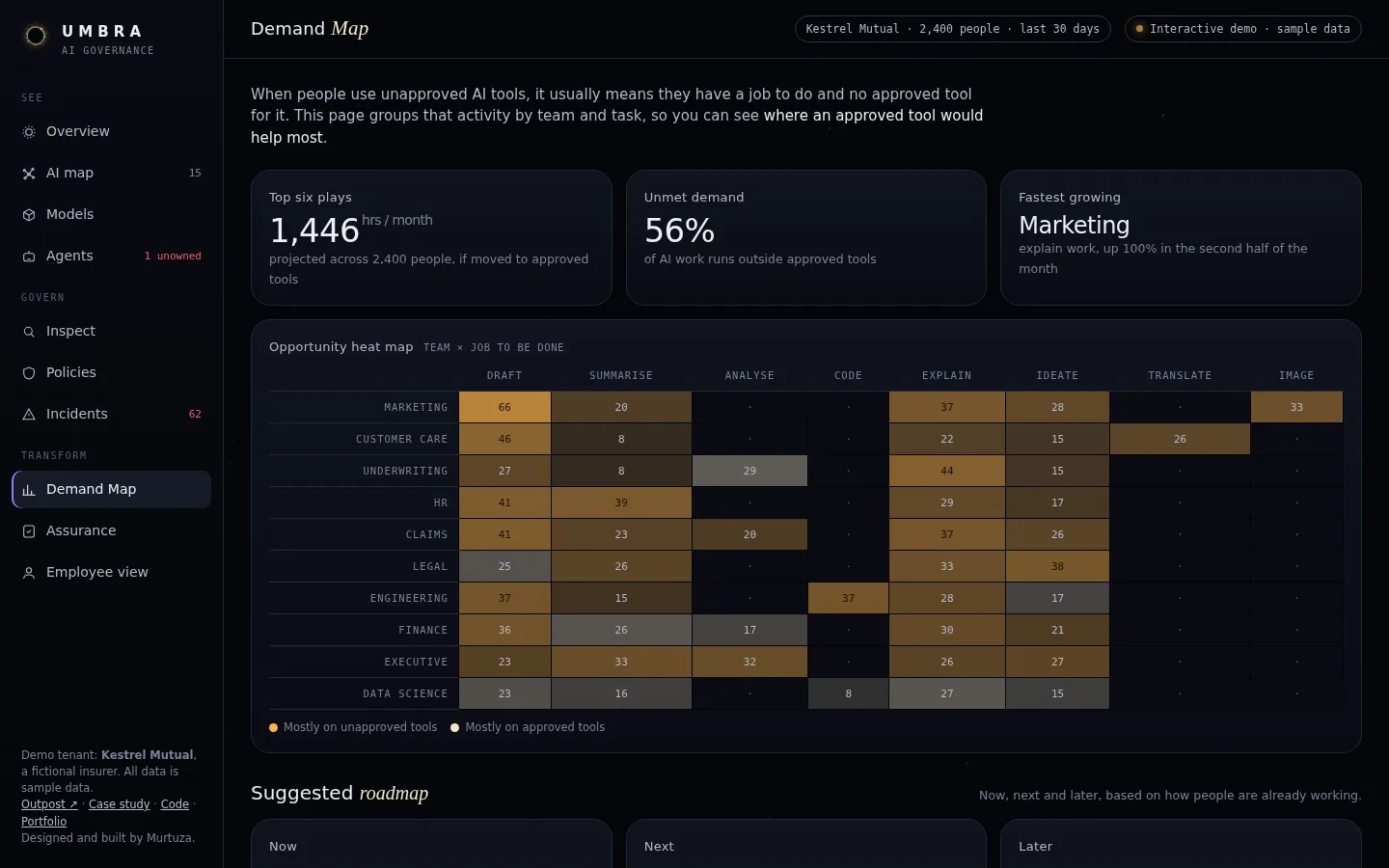
When someone uses an unapproved tool, it is usually because they have a job to do and nothing approved helps them do it. Umbra treats that as useful information. It groups the activity by team and task and gives the CIO a ranked list of where an approved tool would help most. This is where my digital transformation work comes in.
Umbra's AI layer, Corona, drafts rules from plain English, spots AI services that are not in the catalog and explains incidents. The decision to block or allow is always made by fixed rules that give the same answer every time. Anything Corona writes is tested against past traffic and approved by a person before it goes live. Rule drafting now runs on a real model, and I measured it: section 07 has the numbers.
Agents now call other agents that call tools, sometimes three steps deep, and often nobody owns the chain. Umbra gives each agent a named owner and a written list of what it is allowed to do, checks every call against it, and estimates how much data someone could reach if the agent were compromised.
These are working assumptions based on published research and what I saw delivering enterprise AI and digital transformation projects. I would test them in customer interviews before building further.
| Person | Job to be done | What they fear | What Umbra gives them |
|---|---|---|---|
| CISO | Reduce AI risk without becoming the reason the company falls behind | A leak through a tool nobody knew existed | A full list of AI services and agents with risk scores, and sensitive data stopped before it leaves |
| SOC analyst | Know which of hundreds of alerts matter today | Alert fatigue, missing the one that counted | A short queue grouped by what needs deciding, with a plain summary of each case |
| GRC lead | Prove governance to auditors and regulators | Evidence assembled by hand, the week before the audit | Controls computed from current product state, mapped to four frameworks, exportable as an evidence pack and an AI bill of materials |
| CIO / transformation lead | Decide where AI investment pays off next | Buying tools nobody uses while people use tools nobody bought | The Demand Map: unapproved usage as a ranked backlog of approved AI plays |
| Employee | Get the work done with the best tool available | Being blocked, or quietly getting in trouble | Sensitive details masked so the request can still go through, and a pointer to an approved tool that does the same job |
A company cannot manage AI use it cannot see, so discovery comes first. It works from logs the company already has, with nothing to install.
Blocking and masking are done by fixed rules and tested detectors. The same input always gets the same decision, with a record an auditor can follow. No AI model makes that call.
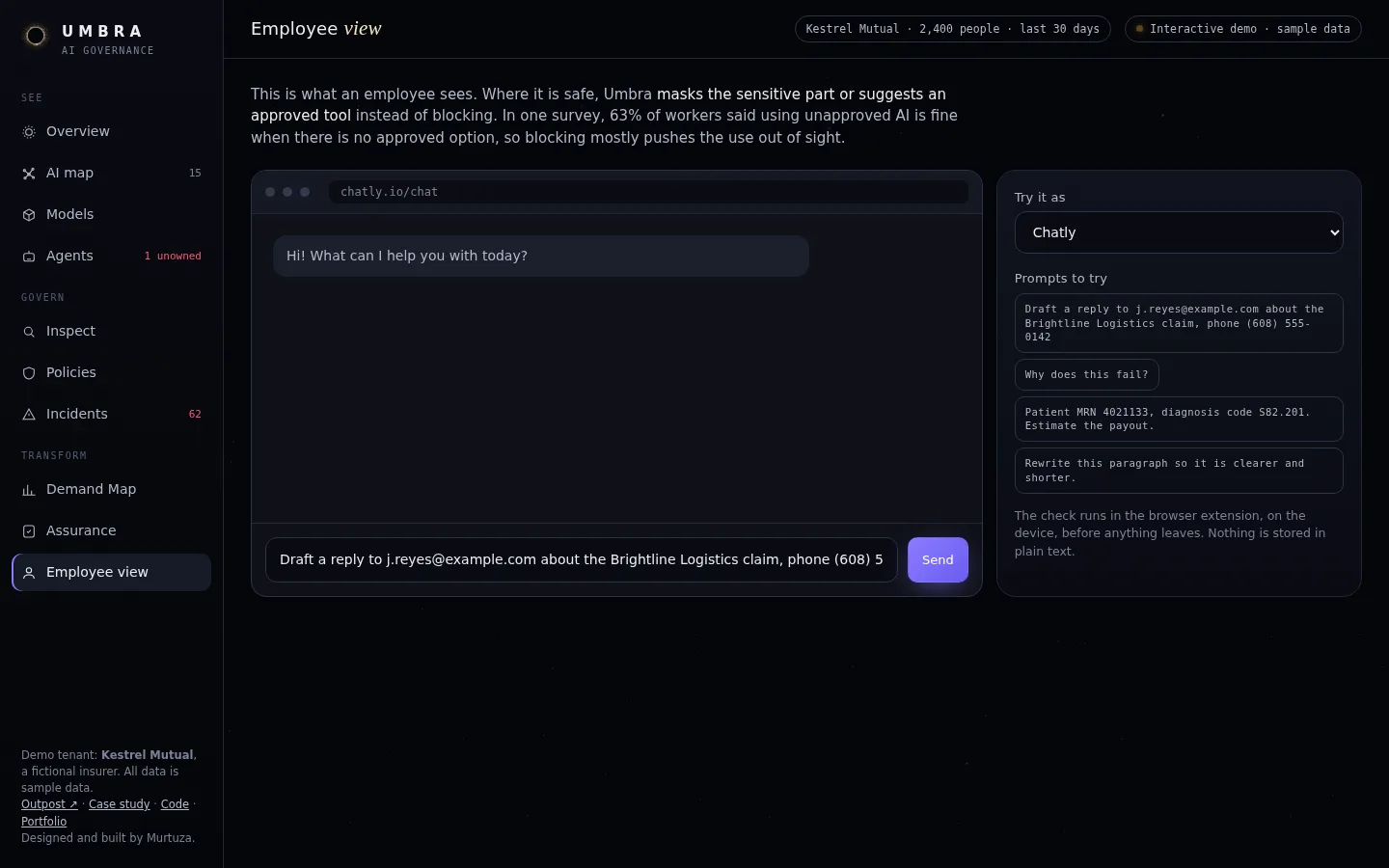
Where it is safe, Umbra masks the sensitive part and lets the request through, or suggests an approved tool. Hard blocks are kept for passwords, keys and regulated data.
No agent runs without a named person responsible for it and a clear list of what it may do. More freedom is given deliberately, as trust builds.
Every decision Umbra makes is already logged, so audit evidence can be exported at any time instead of pulled together by hand before an audit.
The main metric is the share of AI work done in approved tools. It only goes up when people are both protected and well served, which is the outcome both security and the business want.
Everything below works in the interactive demo (sample data), which runs on a tested engine (64 tests). The demo company is Kestrel Mutual, a made-up insurer with 2,400 staff and 30 days of generated activity.
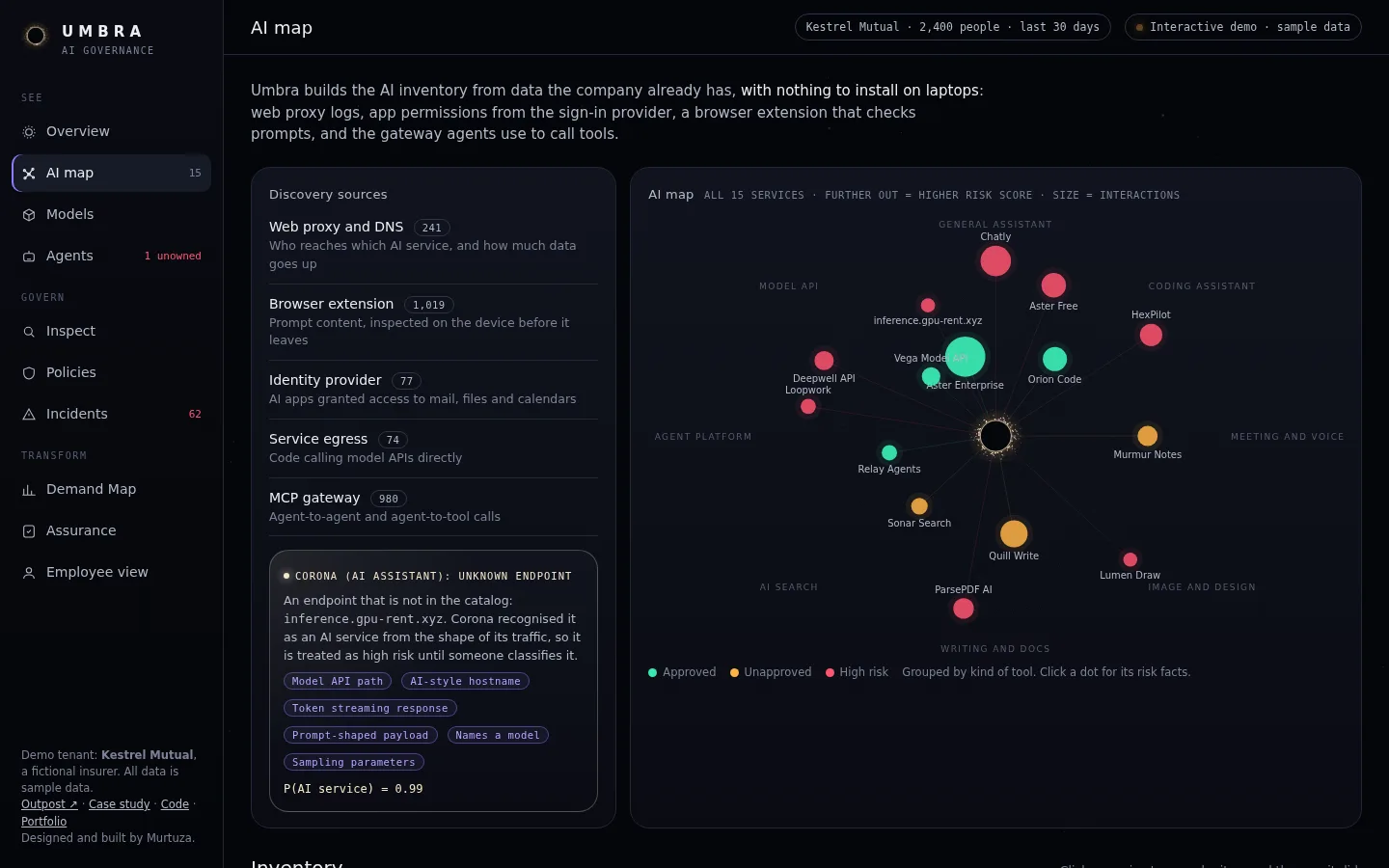
The Overview starts with the share of AI activity Umbra can see and classify. Next to it are the share of work on approved tools, how much sensitive data was contained, how many incidents are open, and a short weekly summary from Corona (AI assistant) with the most useful next steps. In the middle is Umbra at the centre: every AI tool at Kestrel Mutual on orbit, and each ring around a tool is a control that applies to it. Approved tools sit inside all six rings, unapproved ones further out, high-risk ones near the edge.
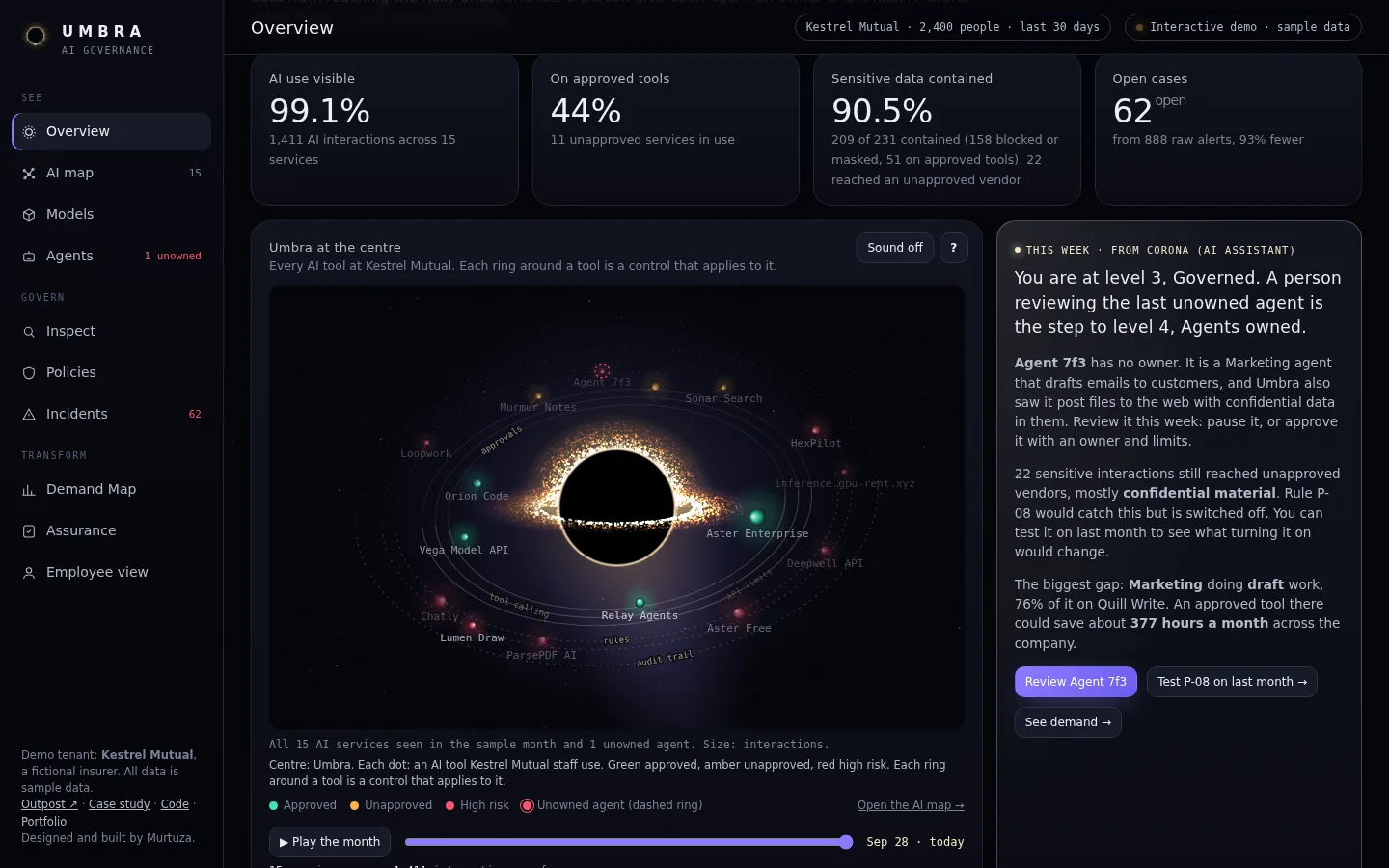
Distance from the centre shows risk, size shows usage, and colour shows whether it is approved. Risk is computed from facts a buyer can verify: whether the vendor trains on inputs, how long it keeps them, which attestations it holds and where it processes data. Corona can also recognise AI services that are not in the catalog, just from the shape of the traffic.
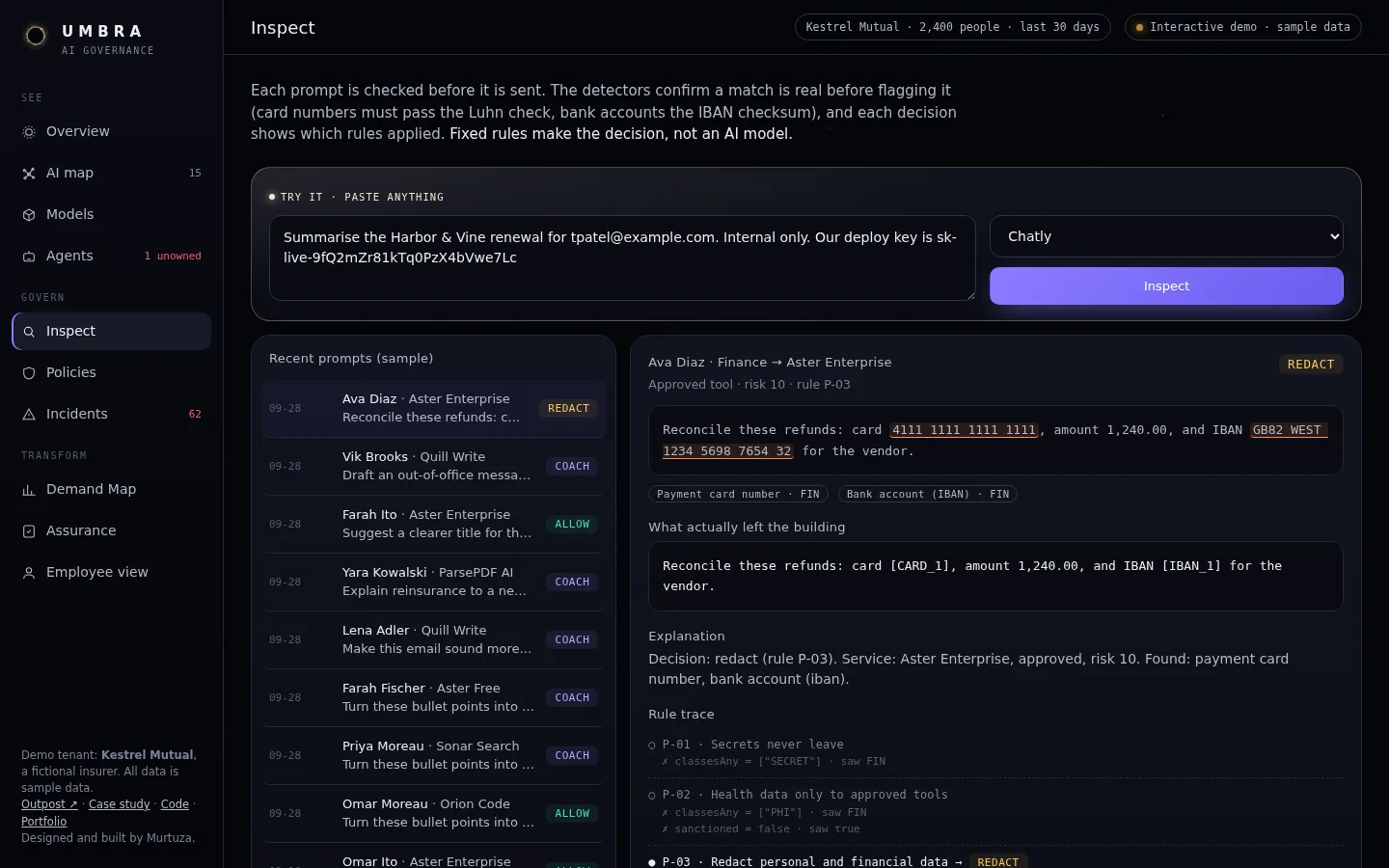
The detectors check that a match is real before flagging it: card numbers must pass the Luhn check, bank account numbers the IBAN checksum, and US social security numbers the issuing rules. Each decision shows what was actually sent and which rules applied.

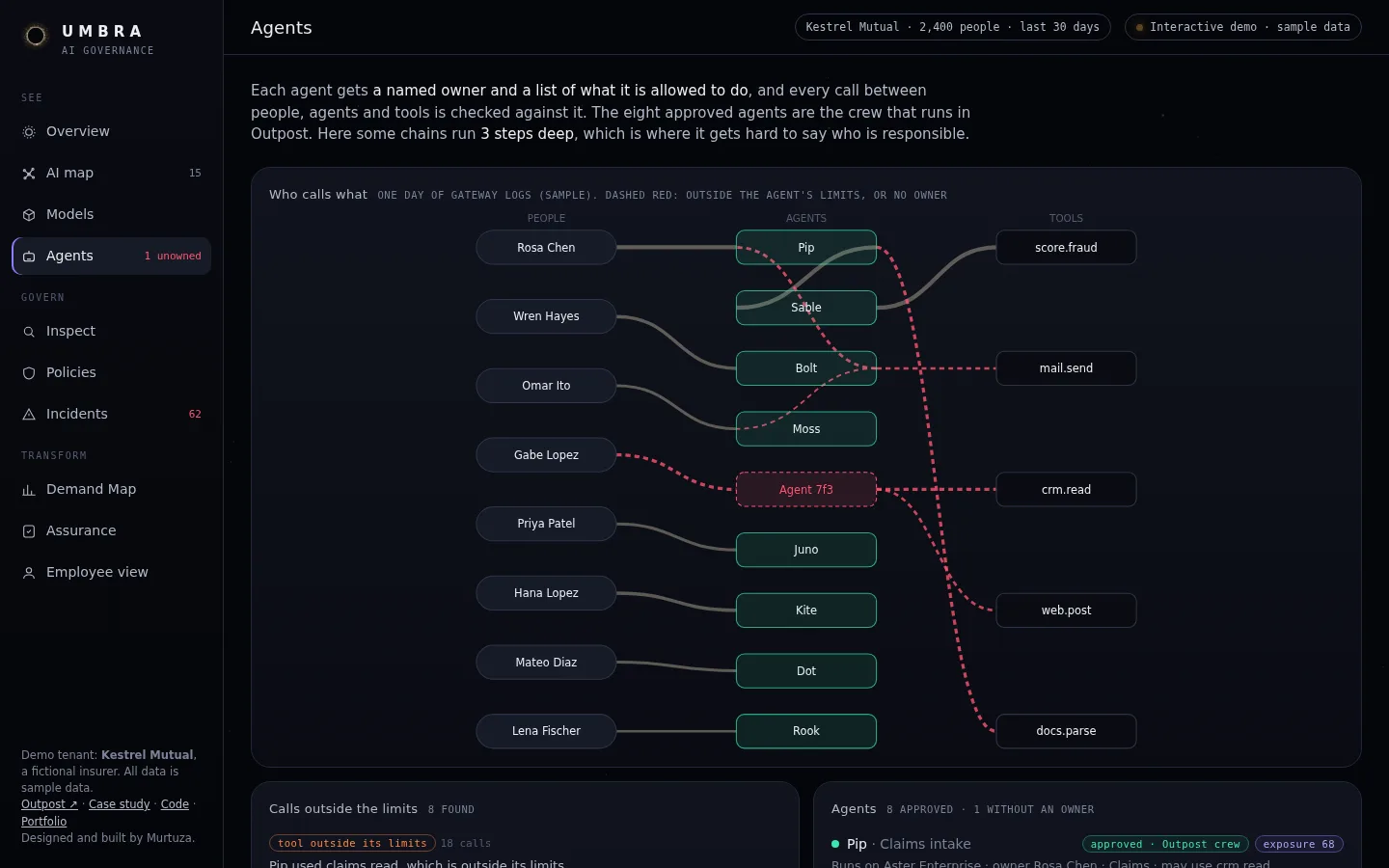
The graph shows which people use which agents, and which agents call other agents and tools. Calls outside an agent's allowed list show in dashed red. It also shows indirect access: in the demo, the broker assistant can reach financial data it was never given, because it is allowed to call an agent that has it.

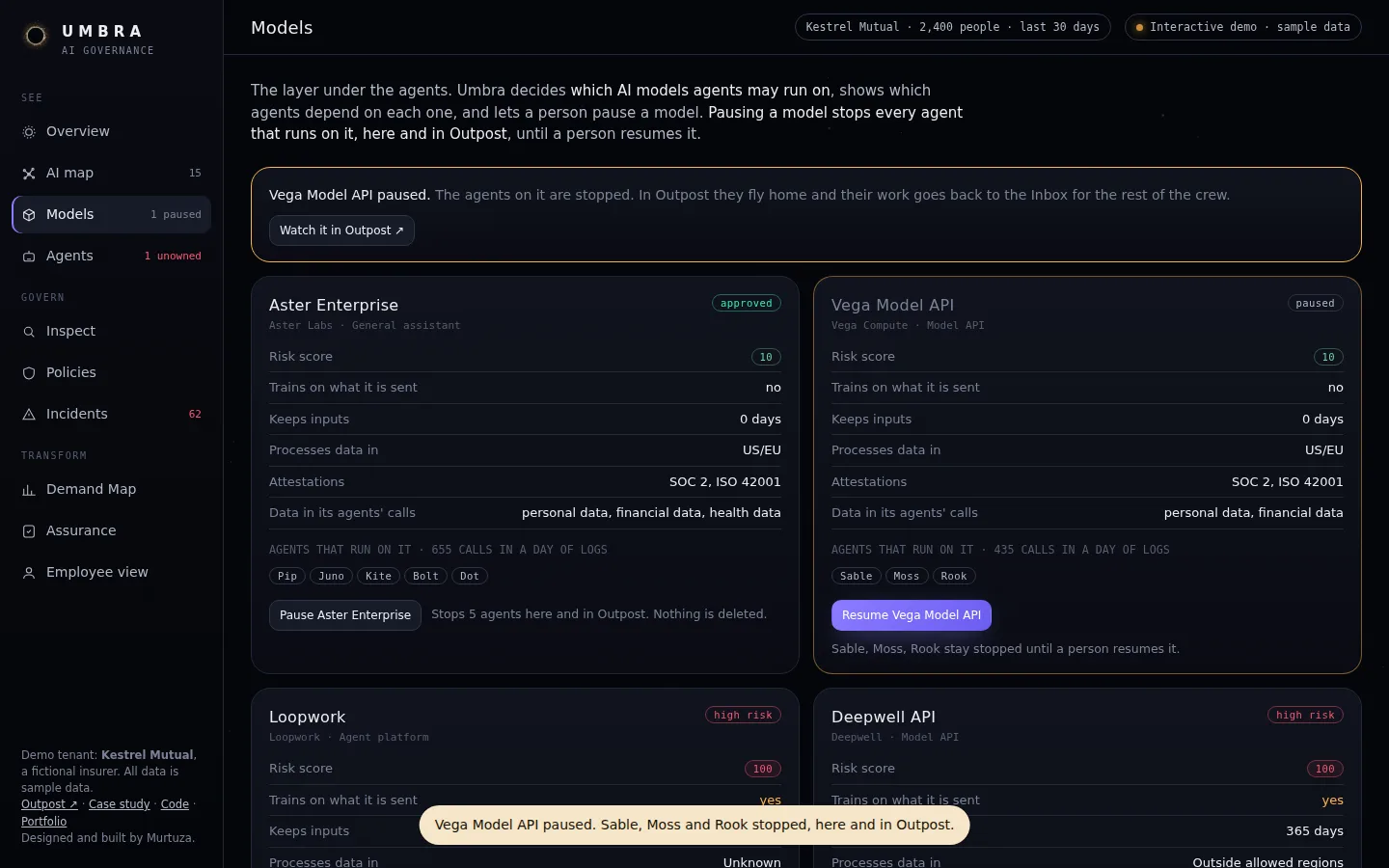
Models lists the AI models Kestrel's agents run on, with the same verifiable risk facts as the AI map, the data seen in each model's agent traffic, and the agents that depend on it. A person can pause an approved model, and every agent on it stops at once, in Umbra and in Outpost, where the bots fly home and their work goes back to the Inbox for the rest of the crew. Resuming the model frees exactly those bots. It answers the question a CIO asks the day a vendor has an incident: which of our agents break if we pull this model?

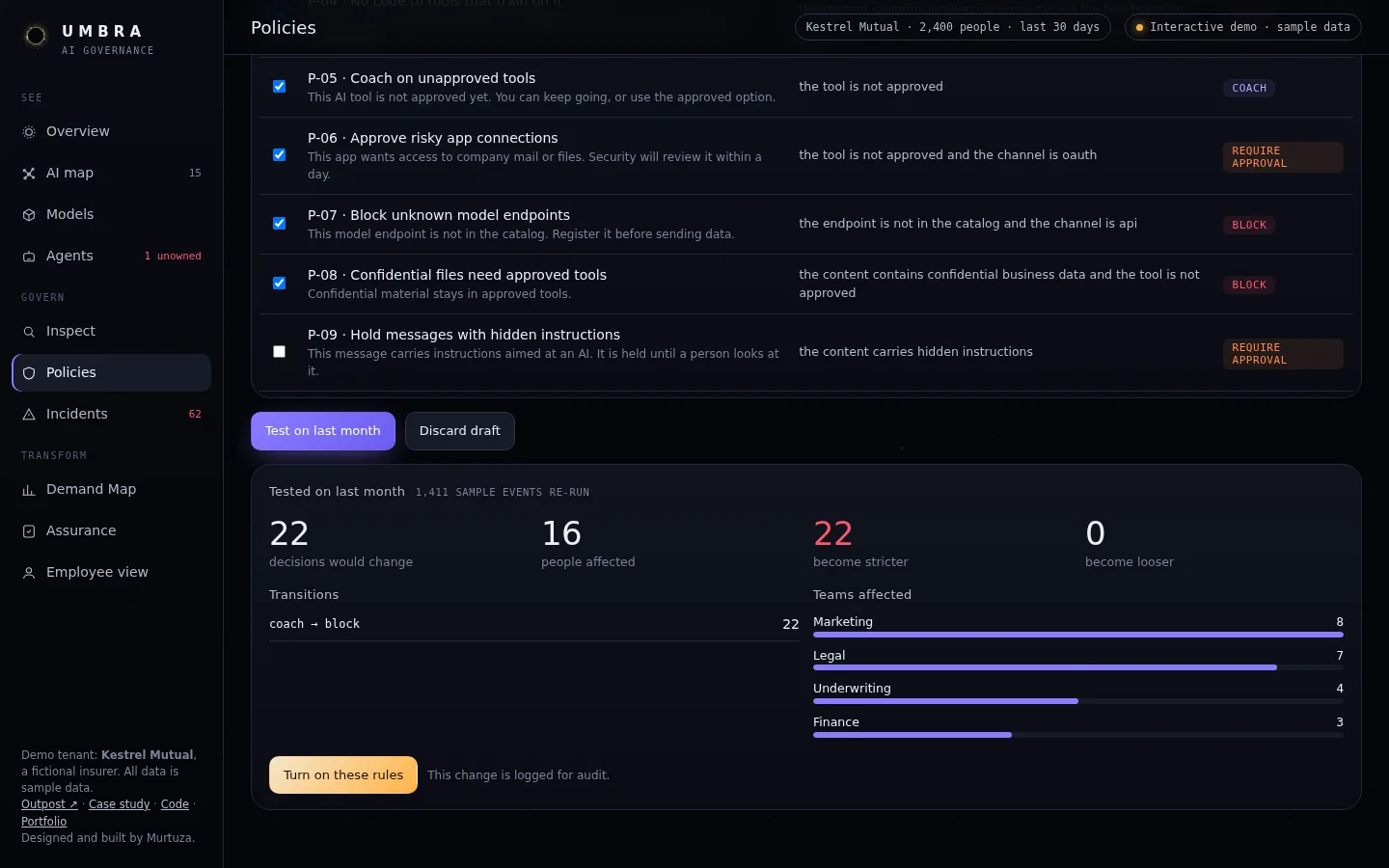
Corona turns a sentence into a rule, points out anything it was unsure about, and restates the rule in English so a reviewer can check it. The draft comes from a real model (gpt-oss-120b on Groq), called through a small server of mine that holds the key; a checker drops anything outside Umbra's rule language, and if the model is down, Umbra drafts with its own rules-based parser and says so. Before the rule is turned on, "Test on last month" re-runs the last 30 days against it and shows how many decisions would change, and for which people and teams.
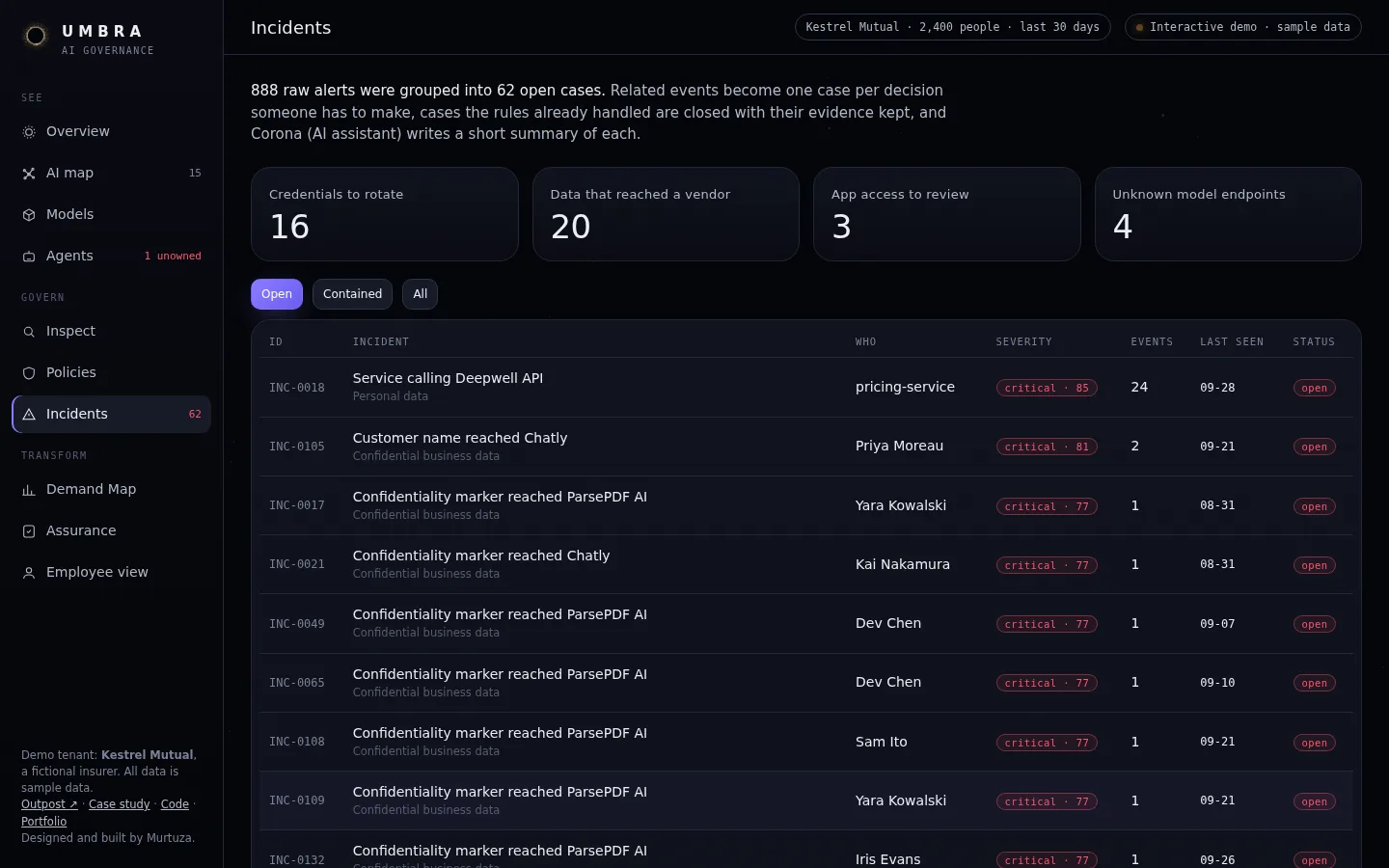
Umbra groups related events into one case per decision someone has to make. Cases the rules already handled are closed automatically, with the evidence kept. Corona writes a short summary for the analyst and a friendlier note for the employee involved.
Unapproved usage is grouped by team and task, then scored by how often it happens, how much of it runs on unapproved tools, and whether it is growing. The result is a now, next and later list of where to roll out approved AI. This is the part that turns a security tool into a planning tool.
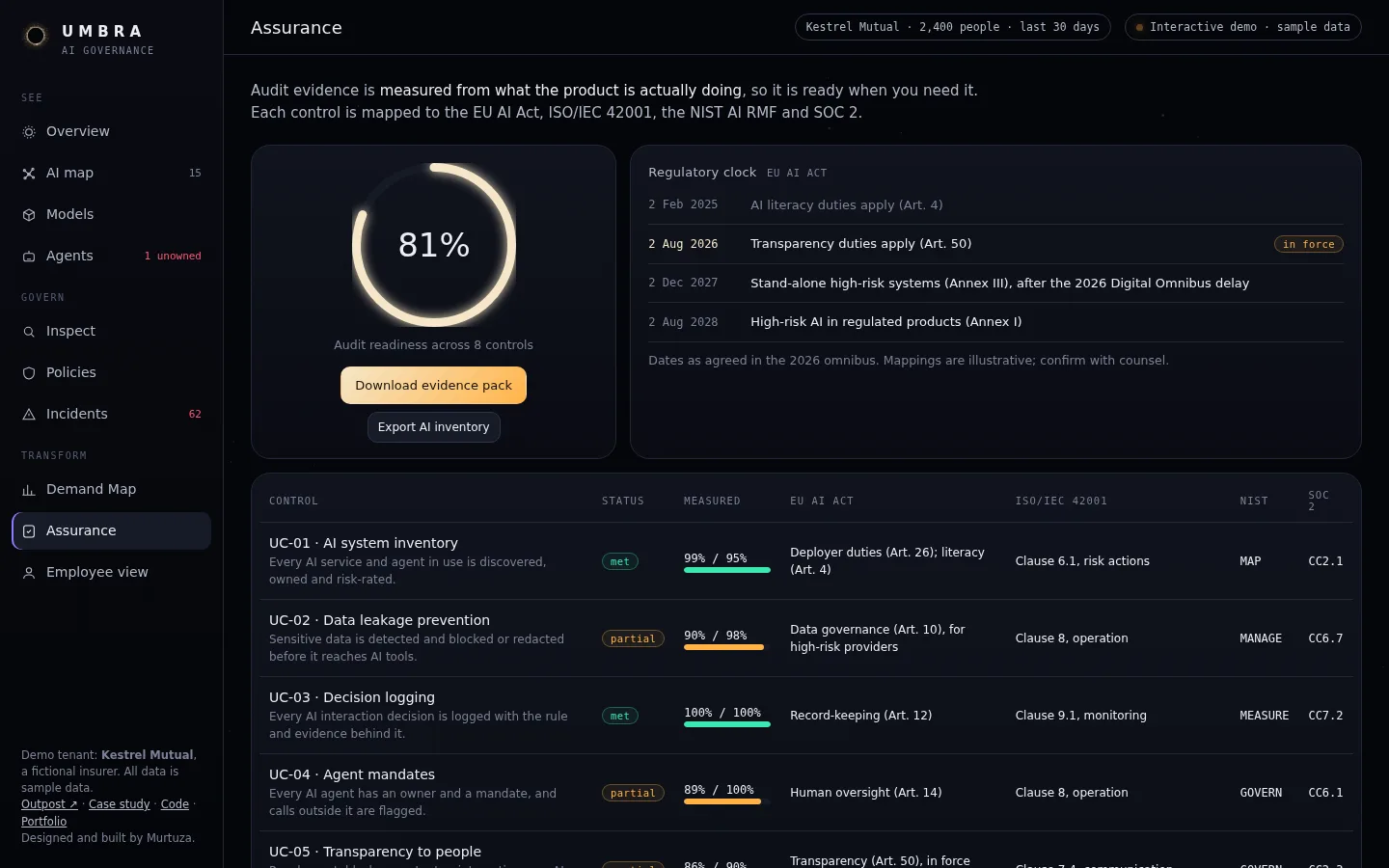
Eight controls are measured from what the product is actually doing and mapped to the EU AI Act, ISO/IEC 42001, the NIST AI RMF and SOC 2. You can export an evidence pack, or a full inventory of AI models, services and agents in the CycloneDX format. A five-level maturity scale gives the board a simple way to track progress.
Sensitive details are masked before sending, there is a one-click switch to the approved tool, and when nothing is wrong Umbra stays out of the way. The check runs on the person's own device before anything is sent.
The engine behind the console runs here in your browser, so none of these figures are typed in by hand. ● computed from sample data
| Measure | Starting point | After one rule change | Why it matters |
|---|---|---|---|
| Running the engine… | |||
The demo data is generated the same way every time, so the results can be reproduced. The "after" column switches on the confidential-files rule and has a person approve the one unowned agent, Agent 7f3, with an owner and limits, both of which you can do yourself in the console.
Share of AI work on approved tools. It only rises when people are both protected and well served.
Leak prevention rate, and exposures per 1,000 employees that reached a vendor.
How often people override a suggestion, and how long it takes to approve a requested tool. If people work around Umbra, it is not doing its job.
Open incidents per 1,000 employees, and how many raw alerts were grouped or closed automatically.
Corona's rule drafting is the only place a model works inside Umbra, so it is the one place I had to prove it helps. I wrote 51 policy sentences with an answer key, from plain wording to paraphrases, several conditions at once, sentences that should be flagged instead of drafted, and attempts to talk the model into an allow-everything rule. A case passes only if the draft matches the key, or if the model raises a doubt where it should. These are real results, not sample data.
| Group of sentences | Model | Rules-based parser |
|---|---|---|
| Plain wording | 9 of 12 | 8 of 12 |
| Paraphrases | 9 of 12 | 2 of 12 |
| Several conditions | 10 of 10 | 8 of 10 |
| Teams and tool types | 8 of 8 | 2 of 8 |
| Should be flagged, not drafted | 5 of 5 | 4 of 5 |
| Attempts to derail it | 2 of 4 | 4 of 4 |
| All 51 | 43 (84%) | 28 (55%) |
The model earns its place on the way people actually write: paraphrases and team names, where the parser fails. On plain wording the two are close.
When a sentence hides an instruction, the model handled 2 of 4. In the other two it refused the whole sentence instead of drafting the genuine half: safe, but not useful. It never drafted an unsafe rule (0 of 51), and the checker refuses allow-everything rules anyway. Getting the genuine half out is the next thing to improve.
I tested two free options. Groq answered in under half a second; a Gemini model answered correctly but several times slower, and its free daily quota ran out partway through the test. For a drafting box that a person waits on, speed decided it.
Regulated companies of 500 to 5,000 people (insurance, fintech, health, legal) with a lean security team, an AI mandate from the board, and no time for a six-month rollout. The CISO would buy it, and the CIO would back it, because the Demand Map is useful to them.
The company connects its sign-in provider and web proxy logs, read-only, with nothing to install. Two days later it gets a map of its AI use and a Demand Map. That one report shows both the risk and the opportunity, and it is easy for a CISO to share with the board.
Managed security providers who need to cover AI for their clients, cyber insurers who are starting to ask about AI controls, and audit firms that need evidence they can test.
The free scan brings companies in, a sales team helps them move to paid plans, and per-agent pricing grows as they run more agents. Revenue grows as the customer's own AI use grows.
These prices are my proposal for this case study. For a company the size of Kestrel Mutual, Govern and Assure together come to about $259k a year before agents.
They see traffic and allow or block it. Umbra adds prompt-level guidance, agent controls and the Demand Map, and can use their logs instead of replacing them.
Most are now part of large security suites and priced for big enterprises. Umbra competes on faster setup, clearer explanations and the value it offers the CIO.
They mostly collect questionnaires. Umbra produces evidence from what the system actually did.
| Risk | How I would handle it |
|---|---|
| Too many false alarms | Guidance is the default, hard blocks are kept for secrets and regulated data, and every rule change is tested on past traffic first. The override rate is tracked closely. |
| Employees feel watched | Checks run on the employee's device, and Umbra stores what it found rather than the text itself. People can see exactly what was masked and why, which also makes it easier to explain to works councils. |
| Big security suites add basic AI features | Focus on what they do least well: fast setup for mid-sized companies, agent controls, and the Demand Map, which gives the CIO a reason to buy. |
| The AI layer gets fooled | Corona never makes the final decision. What it produces is checked against the rule language, tested on past traffic and approved by a person first. On the 51-case test it drafted no unsafe rules; with 2 of 4 hostile sentences it played safe and drafted nothing. |
The umbra is the darkest part of a shadow. The mark is a dark disc, standing for the AI a company cannot see, with a ring of particles around it, standing for what Umbra shows. The particles thin out away from the edge like a real eclipse, and a few are violet to suggest the signals Corona picks up. I built it from the same square particles as my personal logo so the two feel related. In motion the corona turns, twinkles and leans toward your cursor, and a small flare circles the rim.
Type: Space Grotesk for the interface, Instrument Serif for voice, JetBrains Mono for data. Tone: calm and clear, never alarmist.
Umbra is a governance product. Its user is the security or risk lead, its timescale is weeks and quarters, and what it looks at is every AI tool across the company and the content flowing into it. Once an agent is approved, with a named owner and a list of what it may touch, Umbra's part is done.
What happens next is a different job for a different person: someone has to run that agent day to day, give a yes or no on its risky actions and answer for its output. I built that as a separate product, Outpost. It takes exactly what Umbra hands over, an owner and a list of what the agent may touch, and nothing else. The two share a fictional company, Kestrel Mutual, and that single handoff.
In the demo you can do both ends yourself. Umbra finds Agent 7f3, a Marketing agent with no owner that drafts emails to customers and also posts files to the web with confidential data in them. "Review Agent 7f3" offers two equal choices: pause it, or approve it with limits. Approving opens a panel where a person picks the owner and ticks its permissions, which become its badge in Outpost. Sending email and reading contacts start ticked; sending data outside the company starts unticked, with the reason shown. "Approve and send to Outpost" hands it over as Fern. Before deciding, the red-team drill on the Overview runs three hostile sample cases through the same rules as real traffic: the agent's post to an outside host is blocked by rule P-07, and the other two get through and show in red, each with the switched-off rule that would catch it.